Standing Still Means Falling Behind
Reconstructing Corporate Core Competitiveness and Governance Safeguards through Human-AI Collaboration
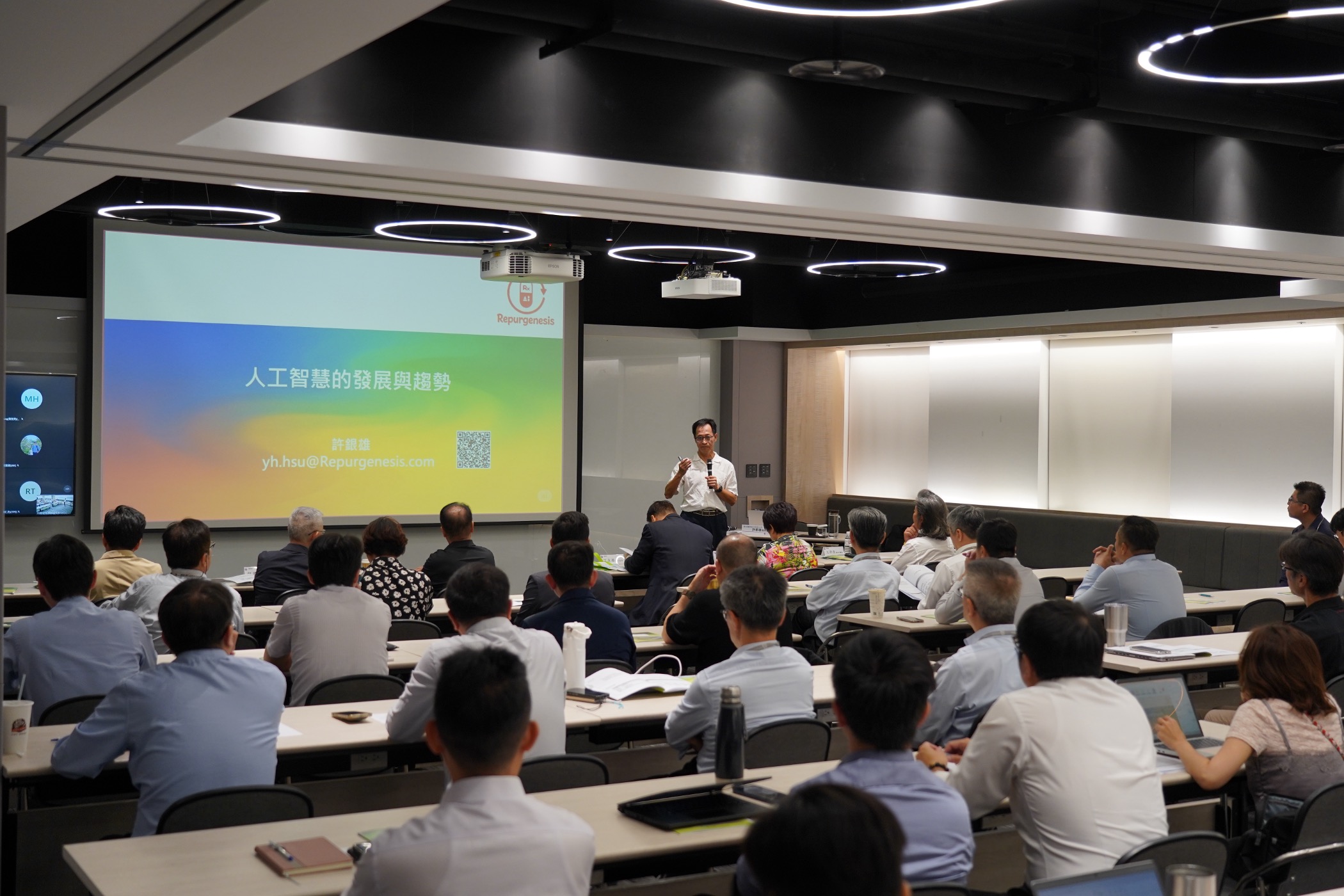
As the global distribution and supply chain landscape for semiconductor components undergoes rapid transformation, AI has evolved from a computational tool into a strategic force reshaping industry competitiveness and redefining corporate governance. Dr. Yin-Hsiung Hsu, an expert in artificial intelligence, smart healthcare, and big data analytics, emphasized in his lecture “The Development and Trends of Artificial Intelligence” that companies choosing to stand still amid the AI wave are not merely maintaining the status quo — they are falling significantly behind as competitors continue to accelerate. The lecture guided directors and senior executives in understanding the trajectory of AI technological evolution, looking ahead to business opportunities alongside the accompanying risks in cybersecurity, regulatory compliance, and governance, and in strengthening the board’s strategic judgment and oversight capabilities.
Key Trends and Technology Insights
Technology Paradigm Shift: AI has evolved from expert systems in the 1980s, through machine learning, to deep learning. While it achieved breakthroughs in fields such as image recognition and smart healthcare, these advances remained largely focused on specific tasks. The Transformer architecture and the attention mechanism drove a key breakthrough in generative AI, enabling AI to conduct self-supervised learning from vast amounts of unlabeled data and evolve into general-purpose intelligent systems. Today, AI is moving further toward Agentic AI, which is capable of autonomous planning, tool use, and task execution. As digital twin technology matures, AI is extending into the physical world — applied to humanoid robots, self-driving vehicles, and smart factories — giving rise to the Physical AI trend that integrates the virtual and physical realms.
Practical Applications for Semiconductor Distributors:Large foundation models depend on massive computing power and capital, and competition in this field is primarily dominated by international technology giants — a scale that individual companies cannot replicate. A company’s true differentiating advantage lies in the operational data and domain knowledge it has accumulated over the long term. By using AI to analyze distributor orders, demand forecasts, and inventory data, companies can calibrate subjective estimates, improve forecast accuracy, and reduce the risk of parts shortages. Integrating product specification sheets with technical databases for intelligent alternative-part matching can significantly shorten search time and speed up responses to customer needs.
Six Dimensions of Risk: These include the hallucination and black-box nature of generative AI; copyright issues in training data and the leakage of sensitive information; new forms of AI-driven cybersecurity threats; reputational risk arising from flawed decision-making; sovereign AI risk from over-reliance on a single foreign model; and the loss of knowledge and experience transfer as AI replaces entry-level work. Companies should establish mechanisms for risk identification, control, and oversight, incorporating AI governance into their corporate governance and risk management frameworks.
Implications for Board Governance and Practical Guidance
The board should oversee the management team in building a comprehensive AI governance framework across four dimensions — strategy, risk, talent, and ethics — capturing the benefits of the technology while safeguarding operational resilience, regulatory compliance, and sustainable development. This includes: establishing a 3-to-5-year AI strategic roadmap and progressively introducing AI into key processes such as ERP, demand forecasting, and alternative-part matching to prevent the erosion of core competitiveness; establishing data classification and enterprise-wide AI usage guidelines to prevent sensitive content from being entered into unapproved external AI services; building a multi-layered “human-AI collaboration” review mechanism that incorporates human-in-the-loop governance to reduce the risk of AI hallucination and cybersecurity threats; reshaping digital talent development and knowledge transfer mechanisms to prevent gaps in experience; and incorporating AI risk, data governance, intellectual property, and ethical issues into the existing governance framework, regularly reviewing the legality and compliance of AI applications, and establishing accountability mechanisms.